Architecture
Overview
Ante follows a clean separation of concerns with a client-daemon architecture. The UI and core logic are decoupled through message passing, making it possible to swap frontends (TUI, headless) without changing the underlying engine.
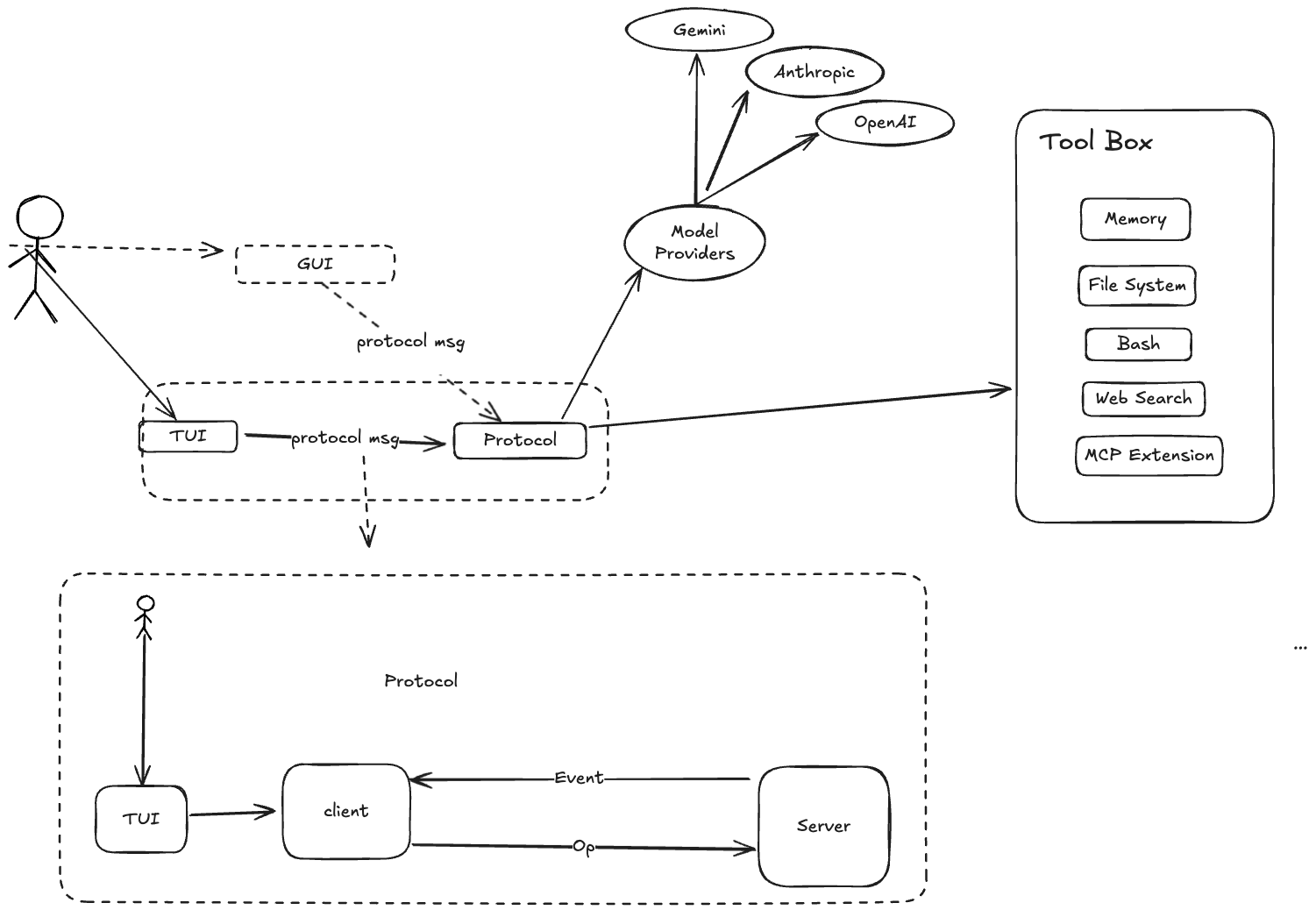
Client-Daemon split
┌────────────────┐          ┌─────────────────────────────┐
│     Client      │    Op    │          Daemon              │
│                 │ ───────▶ │                              │
│  TUI / Headless │          │  Session ─▶ Turn ─▶ Step    │
│  or Serve       │ ◀─────── │                              │
│                 │    Evt   │  Tools    Providers   Store  │
└────────────────┘          └─────────────────────────────┘
- Client — The user-facing layer. The ratatui-based TUI, headless CLI runner, or an external process connected via
ante serve. SendsOpoperations and rendersEvtevents. - Daemon — The core engine. Receives operations, manages sessions, dispatches to LLM providers, schedules tool execution, and emits events.
- Transport — Bounded async channels (Tokio) for in-process clients (TUI, headless), JSONL over stdin/stdout for external clients (
ante serve --stdio), a Unix domain socket for local clients that dial a shared host (ante serve --sock), or WebSocket for networked clients (ante serve --ws). Message IDs enable tracing across the boundary.
Architecture direction: Session-centric to Agent-centric
Ante started with a session-centric runtime where Session is the primary execution owner. We are moving toward an agent-centric runtime, where long-lived Agent instances own execution and communicate through messages.
This is similar to an actor-based model:
- Agent as actor — Each agent has isolated state, a mailbox, and a single logical execution loop.
- Message-driven coordination — Agents coordinate via typed messages/events instead of shared mutable state.
- Hierarchical supervision — Parent agents can spawn child agents (sub-agents), monitor outcomes, and decide retry/escalation policy.
Why this shift:
- Better isolation between concurrent tasks and sub-agents
- Clear ownership of memory, permissions, and tool budgets per agent
- More predictable scaling as workflows become multi-agent
In this direction, Session remains important, but as a container for user interaction history, persistence, and protocol-level coordination rather than the only unit of execution.
LLM providers
Ante is provider-agnostic. Each provider implements a common interface for sending prompts and receiving responses. Transient mid-stream failures reconnect within the turn. Streaming calls that produce no usable event and buffered calls that do not finish within five minutes fail with a timeout instead of hanging indefinitely. That window is per provider — override it with stream_idle_timeout_secs.
| Provider | Wire Format | Models |
|---|---|---|
| Anthropic | Messages API | Claude 4.5 and 5 families |
| Anthropic Subscription | Messages API | Claude family (OAuth) |
| OpenAI | Responses API | GPT-5 family |
| OpenAI Compatible | Chat Completions | Custom models |
| OpenAI Subscription | Responses API | GPT-5 family (OAuth via Codex) |
| Gemini | Gemini API | Gemini 3.x family |
| Vertex AI Gemini | Gemini API | Gemini 3.x family |
| Grok (xAI) | Responses API | Grok 4.6 |
| Zai | OpenAI-compatible | GLM-5.3 |
| Open Router | OpenAI-compatible | Multi-vendor chat models |
| Open Router Responses | Responses API | GPT models over OpenRouter |
| Open Router Anthropic | Messages API | Claude models over OpenRouter |
| DeepSeek | OpenAI-compatible | DeepSeek V4 family |
| Ali Coding Plan | Messages API | Qwen, Kimi, GLM, MiniMax via DashScope |
| Antix | Anthropic Messages | Claude, GPT, Gemini, Qwen, DeepSeek via Antigma |
| Antix (API key) | Anthropic Messages | Same Antix catalog with API-key auth |
| Local | OpenAI-compatible | GGUF models via llama.cpp |
Providers are resolved from a catalog at session init time. The user can override via CLI flags (--provider, --model) or persistent settings.
Authentication
- API keys — Set via environment variables (
ANTHROPIC_API_KEY,OPENAI_API_KEY,GEMINI_API_KEY,XAI_API_KEY,OPENROUTER_API_KEY,OPENAI_COMPATIBLE_API_KEY,ZAI_API_KEY,DEEPSEEK_API_KEY,ALI_CODING_PLAN_API_KEY,VERTEX_GEMINI_API_KEY,ANTIX_API_KEY) - OAuth — Interactive OAuth flow supported for Anthropic, OpenAI, and Antix, handled through the TUI
Tool system
Tools are the agent's hands. Each tool implements the Tool trait:
#[async_trait]
pub trait Tool: Send + Sync {
    fn metadata(&self) -> &ToolMetadata;
    async fn call(&self, input: ToolCallInput) -> Result<ToolCallOutput>;
}
Built-in tools
| Tool | Category | Approval | Description |
|---|---|---|---|
Read | File I/O | No | Read text, image, or PDF file contents |
Write | File I/O | Yes | Create or overwrite files |
Edit | File I/O | Yes | Exact string replacement in files |
Glob | File I/O | No | Find files by pattern |
Grep | File I/O | No | Search file contents with regex |
Bash | Shell | Yes | Execute shell commands; returns a durable handle when a command outlives its max_wait_ms window |
Agent | Builtin | No | Spawn sub-agent for complex tasks |
TodoWrite | Builtin | No | Manage task lists |
WebFetch | Builtin | Yes | Fetch and process web content |
WebSearch | Builtin | Yes | Search the web (auto-enabled on web-search-capable providers) |
ViewImage | Builtin | No | Read and analyze images (opt-in) |
Tool filtering
Tools can be filtered at session level:
- Base list (
--tools) — Replace the default set with exactly these tools - Include list (
--include-tools) — Add tools on top of the default or--toolsbase set - Exclude list (
--exclude-tools) — Remove tools after the base and include lists are applied - Supports ToolMatcher syntax:
Bash(ls -la),Agent(explore) - Names are matched case-insensitively
- The same selection gates dynamically registered tools (MCP servers), so they cannot bypass the filter
Session lifecycle
- Client sends
Op::StartSessionwith model, provider, and policy - Daemon resolves the provider, authenticates, discovers skills and sub-agents
- Daemon creates a
Sessionand emitsEvt::SessionStart - User sends
Op::UserInputto start a task - Session spawns a
Turnwhich communicates with the LLM - Turn executes tools, requests approvals, and eventually completes
- When the context budget nears the limit, auto-compaction evicts aged tool results and summarizes only the older prefix while preserving the recent working state; manual compaction uses a tighter target